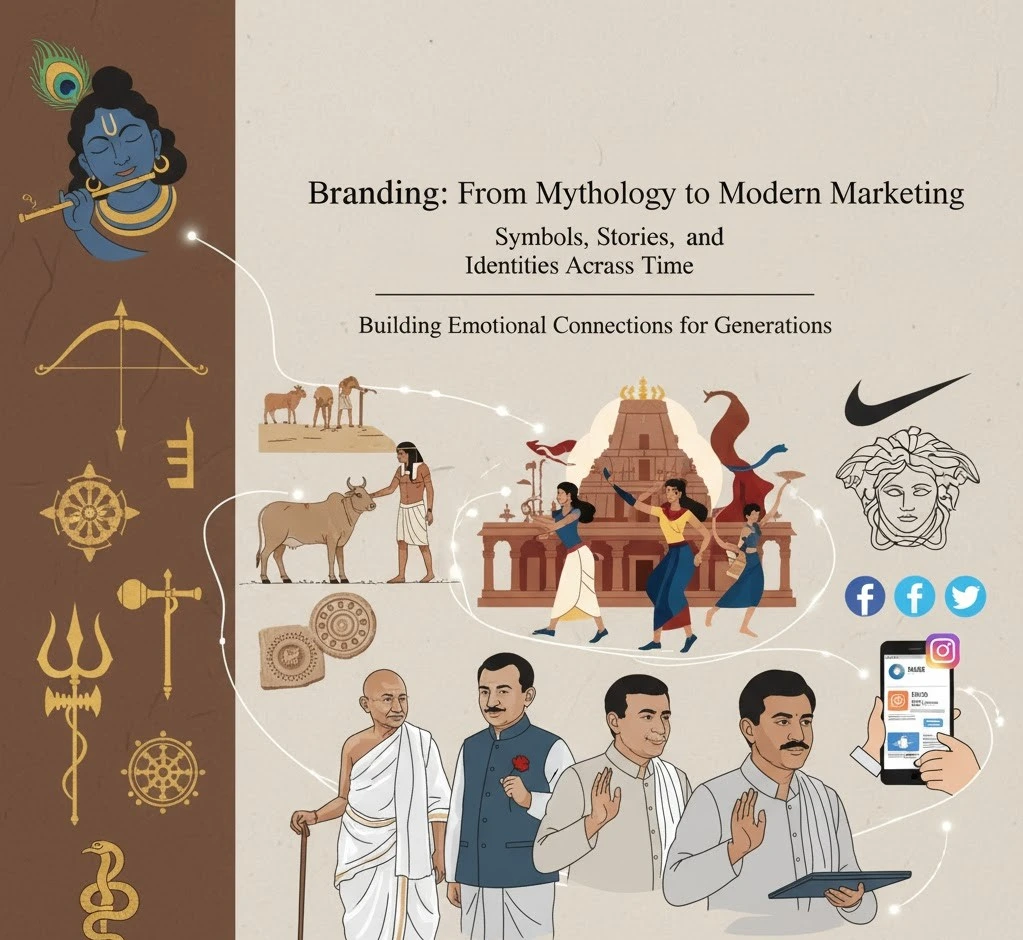
When discussing branding nowadays, the majority of the audience imagines company logos, color schemes, or slogans. But have you ever wondered when branding was first invented? I think branding did not originate in business or advertisements; rather, it started with our mythology and culture.
Branding in Mythology
Imagine what we all heard growing up, of the Mahabharata, the Ramayana, or local legends such as Rajapalayam. The identity of every strong character in the myth was a distinctive symbol denoting their identity.
For example:
His flute and peacock feather (mayilpeeli) are always in remembrance of Lord Krishna.
Arjuna had his bow (villu).
The Vajrayudha was held by Indra.
Bheema had his Gadha.
Sudarshana Chakra was the possession of Lord Vishnu.
The trishul (Shoolam) and a snake were around the neck of Lord Shiva.
Even their chariots and cars had some meaning—each symbolized values, power, or purpose. That was the first kind of branding, the image with symbols, objects, and colors to form identity and recognition. Thousands of years passed, and these mythological identities were transmitted between generations; whether true or fantasy, they left memorable images in the minds of people.
Historical Ancestry of Branding.
Branding also existed in past civilizations. Throughout the period at about 2700 BCE, Egyptian farmers used to mark their animals with a brand to identify their ownership. The Mesopotamian and the Indus Valley traders employed seals and symbols to name their products—a form of logos! These marks created credibility and quality recognition, the same objective of modern branding today.
Branding in the Rel International Religion.
Branding is also done during religious festivals, temple rituals, and community celebrations. They establish emotional attachment, regularity, and identity among the individuals—all the important components of branding.
Religious celebrations and birthdays of leaders are good marketing instruments of communities that strengthen identity, culture, and value systems year after year. Such recognition is cyclical and reinforces the individual memory as well as the collective cultural branding to produce the sense of belonging and continuity.
Branding was also present even during the time of Buddha. Buddha and his disciples were provided with particular regulations, as they had to walk in a special order, at a certain time, with a gentle pace, which became their visual and behavioral image.
In the Freedom Movement, branding is employed.
Going to the modern history, consider Mahatma Gandhi. The simplicity he created in his brand was handspun khadi, long walks, and non-violence. Whenever we think about Gandhi, we recollect his dhoti of khadi and walking stick. It is a good personal brand.
Likewise, Jawaharlal Nehru has developed his own identity by his Nehru jacket—up-to-date, his name is written on it.
Branding in Politics
In Tamil Nadu, such leaders as Jayalalithaa and Karunanidhi also had their iconic styles of clothes, accessories, and even color preferences that became a part of their brand.
In Kerala, V. S. Achuthanand had a strong, rhythmic speech, which was articulate, emotive, and motivating to the working class. His oratory appealed to the farmers and workers; his image in the media was strong and genuine.
Likewise, K. Karunakaran, E. K. Nayanar, and other leaders developed their own distinct communication style as well as part of personal branding.
Even such figures in world history as Abraham Lincoln, Hitler, and so forth, made their mark on the brand by speech, dressing, or behavior that was memorable and made an impression.
Branding in Cinema
In the film, the same trend is present. As an example, Rajinikanth created a good brand name because of the way he walks, his style, and the way he smokes the cigarette. He is a name to himself among fans—that is strong branding.
Conclusion
Branding is ubiquitous, whether in religion, art, politics, and cinema, or business. Since the time of the archaic signs or the present-day marketing, the aim has always been the same: to create a unique image that will remain in the minds of people.
It is not just about logos or colors but stories, emotion, and generation-long relationships.
Popular religious celebrations and the birthdays of the leaders are also influential branding instruments because of the strengthening of collective identity and culture due to repetitions. This enhances communal relationships as well as individual recollections.
Should you wish to create a brand that resonates with people and is enduring, the [best digital marketing strategist in Alappuzha] can assist you to write powerful, culturally sensitive stories that will reach out to your audience on the most personal level.